In-grain colour technology, explained
Why we developed in-grain colour saturation and how it changes the way engineered timber holds tone over twenty years of sunlight.
Most tained timber floors are coloured at the surface. A pigment is rolled or sprayed onto the prepared wear layer, sealed with lacquer or oil, and the colour you see is the colour that sits in the top fraction of a millimetre. It looks beautiful in a showroom. It looks less beautiful after a kitchen chair leg drags across it for the first time and the bare oak underneath shows through.
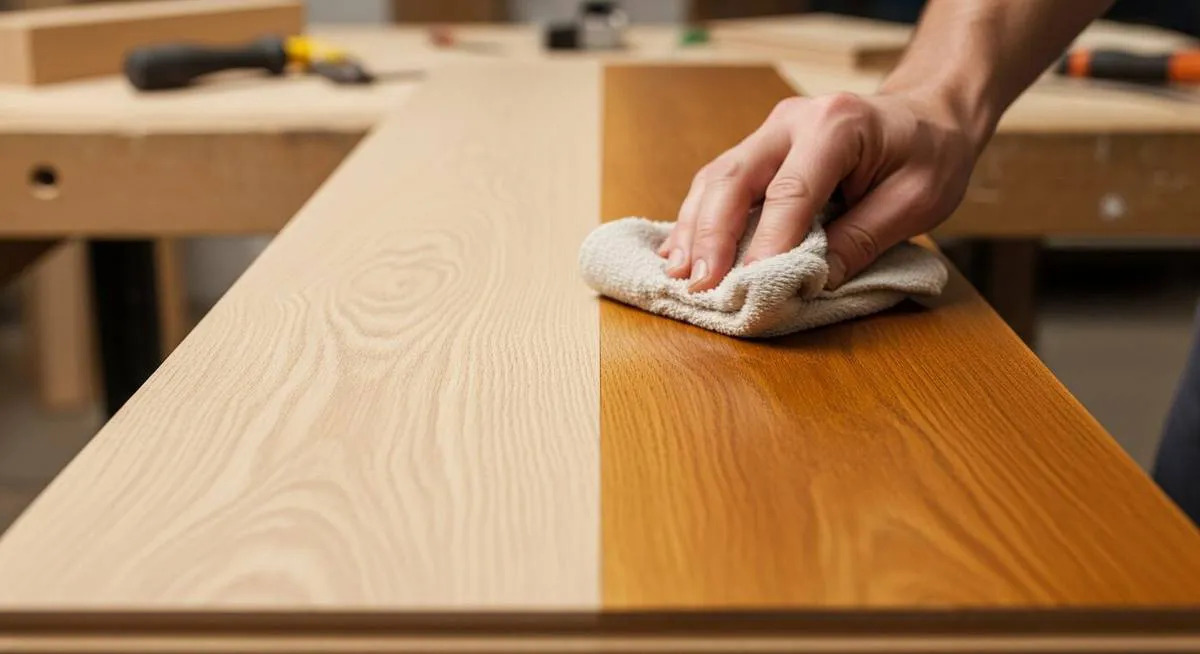
In-Grain is our answer to that problem. The pigment is driven into the wood fibres themselves, so the colour reads not on top of the grain but through it. When the surface eventually wears, what is exposed is the same colour, not the original undyed timber. This article explains how the process works and why it matters for the long life of the floor.
What surface staining cannot do
Surface stains have one fundamental limitation: they only penetrate as deep as the pigment carrier can travel before the lacquer or oil binds the surface. On a tight-grained oak, that is often less than 0.2 mm. Once the lacquer is breached by a deep scratch or worn through by sustained traffic, the original wood colour shows beneath — sometimes by several shades, often unmissably.
It is the reason traditional dark-stained timber floors develop pale wear paths in front of sofas and along hallway centres. The colour was always thin; it had no way to be thicker. The phenomenon is widely understood in the trade and is one of the reasons stained floors are still specified with caution.
How In-Grain works
The In-Grain process drives reactive pigment into the cell structure of the oak under controlled conditions before any finish is applied. The pigment chemically bonds with the wood fibres rather than sitting on them; the colour is part of the timber, not a layer above it. The wear layer is then sealed with a UV-cured lacquer or natural oil depending on the collection.
Because the pigment penetrates millimetres rather than micrometres, surface wear reveals more of the same colour, not a pale layer beneath. A scratch shows as a scratch — not as a bright streak of original oak. The visual effect of ageing is sympathetic instead of disruptive, which is the whole point of the technology.
Where you see it in our range
The technology is central to the Vero collection, where the pale-to-mid tones rely on through-grain colour to retain their character across decades. It also informs colour development across the Forever range, where some of the deeper European tones would otherwise be impossible to deliver convincingly in engineered oak.
The result is most visible after a few years. A surface-stained floor at year five reads as a worn surface; an In-Grain floor at year five reads as a settled, lived-in piece of timber. The colour migrates very slowly, if at all, and the patina is the cumulative effect of light, micro-wear and household life rather than the gradual erosion of a thin top layer.
What it means for refinishing
One of the genuine advantages of In-Grain is that the floor can be re-sanded without losing its colour identity. A traditional surface-stained floor cannot — a full sand strips the pigment back to the bare oak and a re-stain rarely matches the original tone. With In-Grain, the colour goes deeper than the sander travels, so a refinish in fifteen or twenty years recovers the floor without re-staining it.
For a household planning a fifty-year floor, this is not a marketing point — it is the difference between a floor that is genuinely refinishable and a floor that is only theoretically refinishable. Our care article covers the maintenance routine, and the high-traffic guide covers the wear-layer-and-finish decisions that travel alongside this one.
Care and behaviour
An In-Grain floor takes the same daily care as any quality engineered oak — soft-brush vacuum, well-wrung microfibre, pH-neutral cleaner, no steam mops. The pigment does not require special handling; the surface lacquer or oil does. Full guidance is in the maintenance section.
For wider industry context on pigment penetration and timber finishing standards, the Australasian Timber Flooring Association publishes accessible technical notes covering surface treatments and refinishing in Australian conditions.