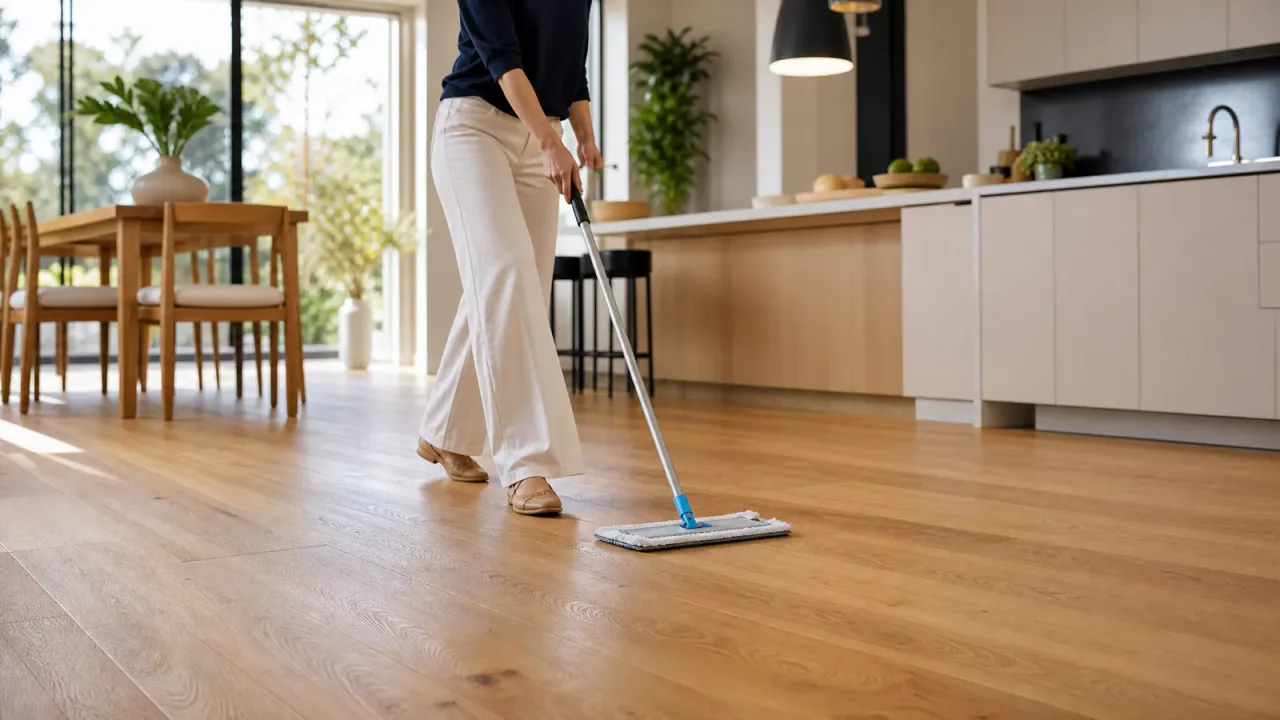

How to choose engineered oak for high-traffic homes
Wide planks, oiled finishes, and grade selection — what actually matters when your floor will live with kids, pets, and Australian summers.
A high-traffic family home is not a punishing environment for engineered timber — it is simply an honest one. Children, pets, three meal services a day and the steady arrival and departure of work boots reveal the floor's real properties faster than any showroom inspection. The good news is that engineered oak is well-suited to this kind of life when the right plank is specified for it.
The trick is matching three variables to the household: wear layer thickness, finish hardness, and plank format. Get those three right and the floor will age the way good furniture ages — slowly, sympathetically, and visibly more loved each year.
Wear layer is the first decision
The wear layer is the solid oak top, bonded to a multi-ply backing. Anything below 2 mm is a thin-veneer product that we do not stock for high-traffic homes; anything at 3 mm or above is suitable for the long term. A 3 mm wear layer can be re-sanded twice across the floor's life, which means a busy household has the option of refreshing rather than replacing in twenty years.
Across our engineered timber range, the wear layer is standardised at 3 mm. The Vero collection and Forever collection are both built to this specification for exactly this reason — long life is not a marketing claim, it is a construction property.
Finish hardness sets the daily behaviour
The factory finish controls how the floor handles claws, sand, dropped toys and dragged chairs. A modern UV-cured lacquer with aluminium-oxide reinforcement is the most abrasion-resistant option for residential timber — typically published to a Taber abrasion result well below the relevant Australian threshold for residential use. A hardwax oil presents differently: softer, more matte, easier to spot-repair, but more demanding on routine.
For a household with children and pets, the lacquer is usually the more honest match. For a quieter household that values the natural feel of oil, the oil finish is worth the maintenance commitment. The matte, satin or brushed guide covers the surface treatment side of the decision.
Plank format affects perceived wear
A 240 mm-wide plank in a five-metre run displays scratches more visibly than a 180 mm plank in the same room, simply because each piece carries more eye and the lighting plays more dramatically across it. Wider planks suit larger rooms with controlled traffic; narrower planks distribute wear visually and forgive scuffs.
For an open-plan family room with sliding doors to a garden, a 190–220 mm format usually balances scale and forgiveness. For a hallway that takes the brunt of the foot traffic, a narrower plank ages better cosmetically.
Colour and grade still matter
Counter-intuitively, very pale and very dark floors show wear more readily than mid-toned ones. A medium oak with visible grain — the natural character of the Eucalypt collection or the mid-tone Forever colours — hides everyday marks because the eye reads the floor as an organic surface rather than a uniform field.
Brushed surface treatments help here too. A lightly brushed surface catches and disperses light unevenly, which means a small scratch reads as part of the texture rather than a flaw. A flat, glossy surface telegraphs every mark, which is one reason we rarely specify high-gloss in family contexts.
Installation choices for traffic
In a high-traffic home, glue-down installation is quieter underfoot and feels more solid; floating with a quality acoustic underlay is acceptable in most residential contexts and faster to install. Our installation comparison covers the trade-offs. Either way, careful subfloor preparation pays for itself across the life of the floor, and a planned screen-and-recoat at year ten extends the apparent youth of the surface by another decade.
For a broader sense of which engineered timber specifications match Australian residential conditions, the Australasian Timber Flooring Association publishes performance benchmarks. Pair that with our technical data hub and the specification almost writes itself.
Planning for the long arc
A 3 mm wear layer, a UV-cured aluminium-oxide lacquer, a mid-tone European oak with a light brush, in a 190 mm format, installed glue-down. That is, in one sentence, the spec we recommend most often for a busy Australian family home. The contact page reaches the studio team for project-specific advice, and the care article covers the maintenance routine that keeps that specification looking right twenty years on.
The other quietly important decision is colour grading. A grade with visible knots and mineral streaks reads as more forgiving than a uniform clear grade, which is one reason the Forever collection ages so gracefully in family rooms. The character is built in; the wear blends into it instead of competing with it.