Caring for engineered timber — daily, seasonal, and decade-by-decade
The right cleaner, what to do about winter heating, when to screen-and-recoat, a practical maintenance schedule for a floor that should outlast your house.
A well-made engineered timber floor asks very little of you, but the little it asks, it asks consistently. Treated kindly, it will look better in twenty years than it did at handover, the patina settling into the grain in a way no factory finish can imitate. Treated indifferently, the same floor will show every spilled glass of wine and every dragged dining chair within a season.
The maintenance routine we recommend is not particularly demanding. It is the rhythm of it that matters, small acts performed often, rather than dramatic ones performed late. This is the schedule we share with every engineered timber client at handover, and it is the same one our long-term retailers train their installers to demonstrate at the end of the install.
The daily routine
Grit is the enemy. The single most damaging thing a residential floor encounters is fine sand and grit carried in on shoe soles, which acts as an abrasive every time someone walks over it. Place generous-sized entry mats inside and out, and sweep or vacuum the main traffic paths daily during winter and weekly the rest of the year. Use a soft-headed vacuum without a rotating beater bar; the spinning brush bar is designed for carpet, not timber.
Spills should be wiped as they happen, not at the end of the evening. The lacquer finish on the Vero and Forever ranges resists water for long enough to clean up a knocked glass, but it is not designed to sit under a puddle for hours.
Weekly cleaning
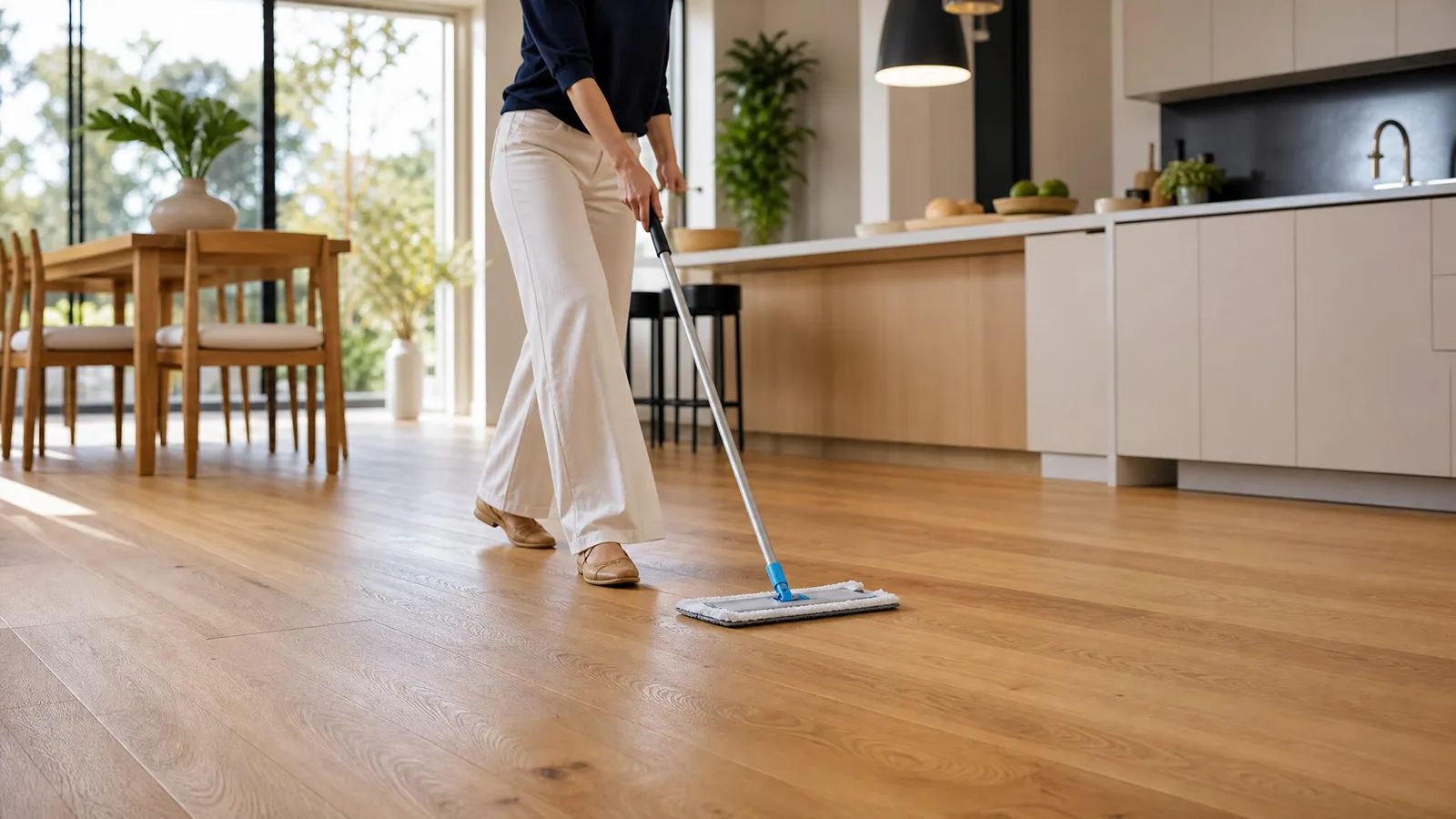
Once a week, damp-mop with a well-wrung microfibre and a pH-neutral timber-specific cleaner. The microfibre should feel barely damp on the hand, not wet. Any moisture on the surface should dry within two to three minutes. Avoid steam mops entirely: the combination of heat and moisture softens a lacquer finish and lets water vapour work its way into the seams between boards, and timber is hygroscopic, so repeated moisture exposure is what causes cupping, gapping, and finish failure over time.
Avoid vinegar, ammonia-based sprays, and anything advertised as a generic multi-surface or degreasing cleaner. These products are formulated for tile and laminate; on a lacquered floor their acidity or alkalinity clouds the finish and, with repeated use, dulls the surface permanently.
If a particular cleaner is not listed on our maintenance guide, the safe answer is to skip it. The list of approved products is short and not coincidentally so. The chemistry of a good timber-specific cleaner is matched to the lacquer our finishing partners use.
Seasonal care
Timber moves with humidity. Australian indoor conditions swing widely across the year, a humid coastal summer can sit well above 60% relative humidity, while a dry winter under forced-air heating can fall to 25% or lower, and the plank moves accordingly. Tiny gaps may open in winter and close again in summer. This is normal. Sustained extremes are the problem: a winter spent at very low humidity, day after day, is what cups and checks a timber floor, not the ordinary seasonal swing.
The fix is conditioning the room, not the floor. Most timber flooring bodies recommend keeping indoor relative humidity in the 40 to 60% band year-round where practical. A hygrometer is inexpensive and changes the conversation. Felt pads under furniture, rugs at entry points, and curtains drawn against direct summer sun do quiet, important work alongside the cleaning routine.
Decade by decade
The reason real timber outlasts every printed alternative is that it can be refreshed. Our standard wear layer is 3 mm. As a rule of thumb across the industry, a professional sand removes roughly 0.5 to 1 mm of timber and a minimum buffer must be left above the core, so a 3 mm wear layer realistically supports one to two full sand-and-refinish cycles over the floor's life, and more if a screen-and-recoat is used to buy time in between, since a screen-and-recoat refreshes the lacquer layer without removing any timber at all.
Most well-maintained residential floors show noticeable wear well before the timber itself needs sanding, which is where a screen-and-recoat earns its keep: a light abrasion of the existing lacquer followed by fresh coats, done in a day, with no dust and minimal disruption. When the floor eventually does need a full sand and refinish, the work is done in place by a flooring contractor and typically takes three to five days for a home. The result is, genuinely, a new-looking floor without removing the old one. Our In-Grain colour article explains why the colour also survives that refinish in our pigmented collections, which is the structural reason a stained engineered floor from us reads differently from a surface-stained alternative after a decade.
What to avoid, and what to plan for
A short list, easier to remember than a long one. Avoid steam mops. Avoid wet-mopping. A floor should be damp-cleaned, never left sitting under water. Avoid wax-based and silicone-based floor polishes and sprays; they build up on top of a lacquer finish, can make the floor slippery, and have to be stripped back before any future recoat will bond properly. Avoid dragging unprotected furniture; lift and place rather than slide. Avoid stiletto heels with damaged tips, which concentrate the weight of a person on a millimetre of metal.
Plan for a screen-and-recoat somewhere in the first decade of normal residential use, sooner in high-traffic areas and later in bedrooms and formal rooms. Add a felt-pad audit every twelve months and a thorough rug-and-mat refresh on the same cycle. Detailed care guidance lives in the maintenance section of the technical data hub, and broader industry-tested guidance is available from the Australasian Timber Flooring Association for those who want to read further on engineered timber stewardship in Australian conditions.