The Second Life of the Rubber Tree
Why Hevea sits at the heart of our engineered timber floors
BEAUTIFUL ON THE SURFACE. SMARTER AT THE CORE.
A beautiful timber floor should do more than look impressive. It should have substance beneath the surface: a stable construction, a traceable story and evidence that stands up when the serious questions are asked.
At The Flooring Lab, many of our engineered timber floors are built around a Hevea brasiliensis core - plantation-grown rubberwood sourced in Indonesia and manufactured with our long-term factory partner, Forestry Timber Export.
Why Hevea? Because this is timber with a second life. After decades producing natural rubber, the tree becomes the engineered heart of a floor designed to perform for years to come.
FIRST LATEX. THEN TIMBER.
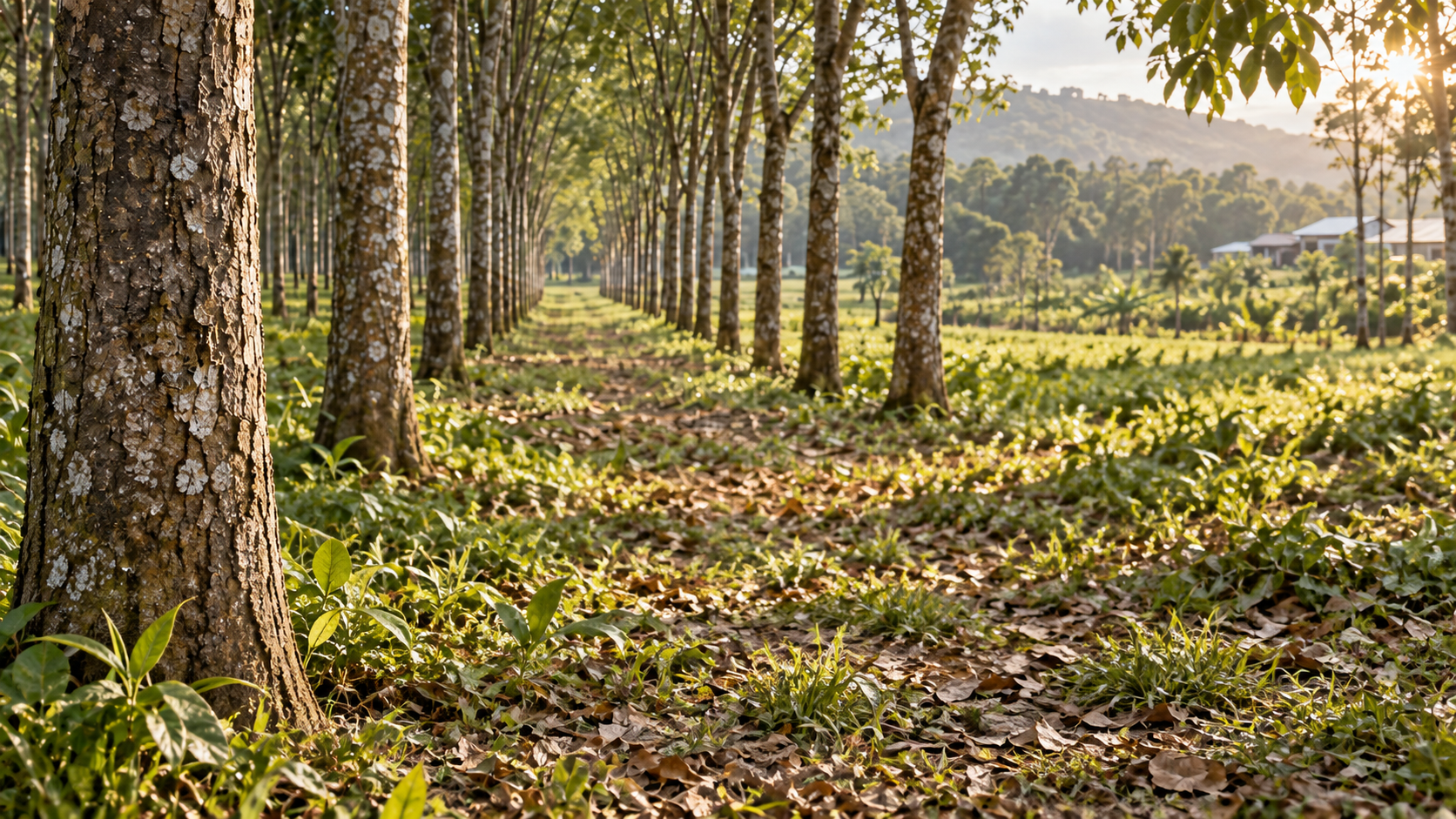
Hevea brasiliensis is grown across Southeast Asia primarily for natural rubber. The trees are generally tapped from around five to seven years of age and can produce latex for approximately 25 to 30 years. When yields decline, the plantation is cleared and replanted.
That leaves a mature, dense and workable hardwood. Instead of the tree being burned or left as waste, its timber can move into furniture, panels and engineered flooring cores.
This is the real strength of the Hevea story: it makes productive use of an end-of-cycle plantation resource. It is not timber harvested from natural forest solely to manufacture flooring.
A SECOND LIFE WITH REAL VALUE
Using plantation rubberwood can help:
• turn end-of-cycle plantation trees into a valuable manufacturing resource • reduce demand for slower-growing hardwoods sourced from natural forests • support the replanting cycle and the smallholder communities connected to it
Indonesia has one of the world's largest rubber plantation estates, with much of its production linked to smallholders, particularly in Sumatra. When Hevea enters a responsible manufacturing chain, the story reaches beyond engineering. It connects plantation renewal, local livelihoods and more intelligent use of an existing resource.
THE HONEST VERSION
A rubber plantation is not the same as primary rainforest, and we do not pretend it is. The responsible claim is clear: Hevea gives an existing plantation tree a valuable second life at replanting. That is the story - and it is strong enough without being stretched.
BUILT TO HOLD ITS GROUND
The core of an engineered floor does the quiet work. It supports the surface, manages movement and helps wide boards remain stable as temperature, moisture and humidity change.
Forestry Timber specifies Hevea because it performs like a serious hardwood, with density and strength in a similar class to White Oak. Arranged in a multi-stave core, it creates the stable foundation that engineered timber flooring demands. European Oak or Australian species create the face you see and live on. Plantation Hevea forms the engineered heart that helps keep the board true.
GOOD LOOKS GET ATTENTION. THE CORE EARNS TRUST.
This is the difference between choosing timber for appearance alone and engineering a complete floor. The surface makes the design statement. The construction makes it last.
LEGALITY WITHOUT THE FOG
When Indonesian timber enters the conversation, two names matter: SVLK and FLEGT. They are connected, but they are not interchangeable.
SVLK - Sistem Verifikasi Legalitas Kayu - Indonesia's timber legality verification system. The question: Was the timber legally harvested, processed and traded under Indonesian law? The role: Indonesia's national mandatory legality framework for relevant timber trade FLEGT - Forest Law Enforcement Governance and Trade - the EU and Indonesia trade framework. The question: Can the shipment carry a FLEGT licence confirming verified legality under the EU and Indonesia agreement? The role: A trade licence built on the SVLK system for applicable exports to the European Union
Forestry Timber identifies SVLK and FLEGT within its certification framework and supplies FLEGT-licensed material into European markets where applicable.
For Australian importers and specifiers, SVLK and V-Legal documentation provide practical evidence that supports due diligence under the Illegal Logging Prohibition Act 2012 and the Illegal Logging Prohibition Rules 2024, including Australia's Indonesia Country Specific Guideline.
FLEGT licences are an EU trade instrument. Australia does not import timber under the FLEGT licensing system. The documentation may still demonstrate the same underlying SVLK legality controls, but it does not replace an Australian importer's own written due-diligence system.
LEGALITY AND CERTIFICATION ARE NOT THE SAME QUESTION
FSC and PEFC are voluntary certification systems covering responsible forest management and chain of custody through to a product claim. SVLK and FLEGT address legality. These systems do different jobs, and one should not be presented as a substitute for another.
Hevea can be FSC certified. However, an engineered board made with a Hevea core may not always carry an FSC or PEFC product claim. That does not automatically make the timber illegal or unregulated. It reflects the reality of the supply chain.
1. Different proof. SVLK and FLEGT verify legality. FSC and PEFC certify responsible forest management and chain of custody. The claims are related, but not identical. 2. Smallholder complexity. Much of Indonesia's rubber supply comes from many small plots. Latex and timber can move through collectors and dealers before reaching the mill, making a complete certified chain of custody difficult and expensive to maintain. 3. The whole board matters. An engineered floor contains multiple layers. Even if the face timber or a particular batch is certified, an uncertified core may prevent the finished board from carrying an FSC or PEFC product claim unless every relevant component remains within the certified chain. 4. Availability is not a blanket claim. Forestry Timber can offer FSC or PEFC lumber on request for relevant products. That does not mean every Hevea-core product or SKU automatically carries that certification.
WHEN A PROJECT ASKS FOR FSC FLOORING
Our answer is direct. If the selected Hevea-core construction cannot carry an FSC or PEFC product claim, we will not imply that it can. We can provide the legality evidence that applies, explain the plantation second-life story and support the product with relevant indoor-air and life-cycle documentation, such as FloorScore certification and Environmental Product Declarations where available.
Where an FSC product label is mandatory, we can discuss alternative constructions that are able to carry that claim.
Clear evidence beats stretched language. Every time.
WHAT TO REQUEST IN A PROJECT PACK
• the Forestry Timber Hevea core and construction explanation • SVLK documentation and relevant V-Legal or FLEGT paperwork where issued • FloorScore certification and an Environmental Product Declaration where available • face-species origin information and any FSC or PEFC claims that apply to the specific product line Certificates and supporting information for our manufacturing partner are available at forestrytimber.com.
THE FLOORING LAB VIEW
We specify Hevea because it is strong, stable and already part of an established plantation cycle for natural rubber. We explain SVLK and FLEGT because legal origin matters. And we are precise about FSC and PEFC: when a product carries the claim, we use it; when it does not, we say so and provide the evidence that does apply.
From plantation to plank. One tree. Two productive lives. One seriously considered floor.